• Skip to primary navigation
  • Skip to main content
  • Skip to primary sidebar
Penn BGS Career Development

BGS Career Development

Making It Count!

  • Core Competencies
  • Career Paths
  • Career Blog
  • Career Paths Mentorship Program
  • Alumni Outcomes

Rebecca Lopez

2020-2021 Penn 3MT Competition

February 17, 2021 by Rebecca Lopez

Image result for grad center at penn logo

Deadline: March 15, 2021

Penn 3MT is a university-sponsored competitive speaking competition designed to showcase graduate student research in three-minute talks to a general audience. This is a terrific opportunity for graduate students engaged in substantive original research to develop communication skills and share their work with faculty, students, and staff from across the University.

In addition to bragging rights, prizes will be awarded to the top three winners and an audience choice winner. To enter, students must submit a video of their three-minute talk to Penn 3MT. From those submissions, finalists will be chosen to compete in the campus wide online competition.

Learn more and submit your video: https://bit.ly/3_MT

Cosponsored by GAPSA, Penn Libraries, Career Services, CURF, and the Grad Center
Filed Under: Announcements Tagged With: Career: Research (academic), Competency: Communication

Penn Society for Psychedelic Science Seminar Series

February 17, 2021 by Rebecca Lopez

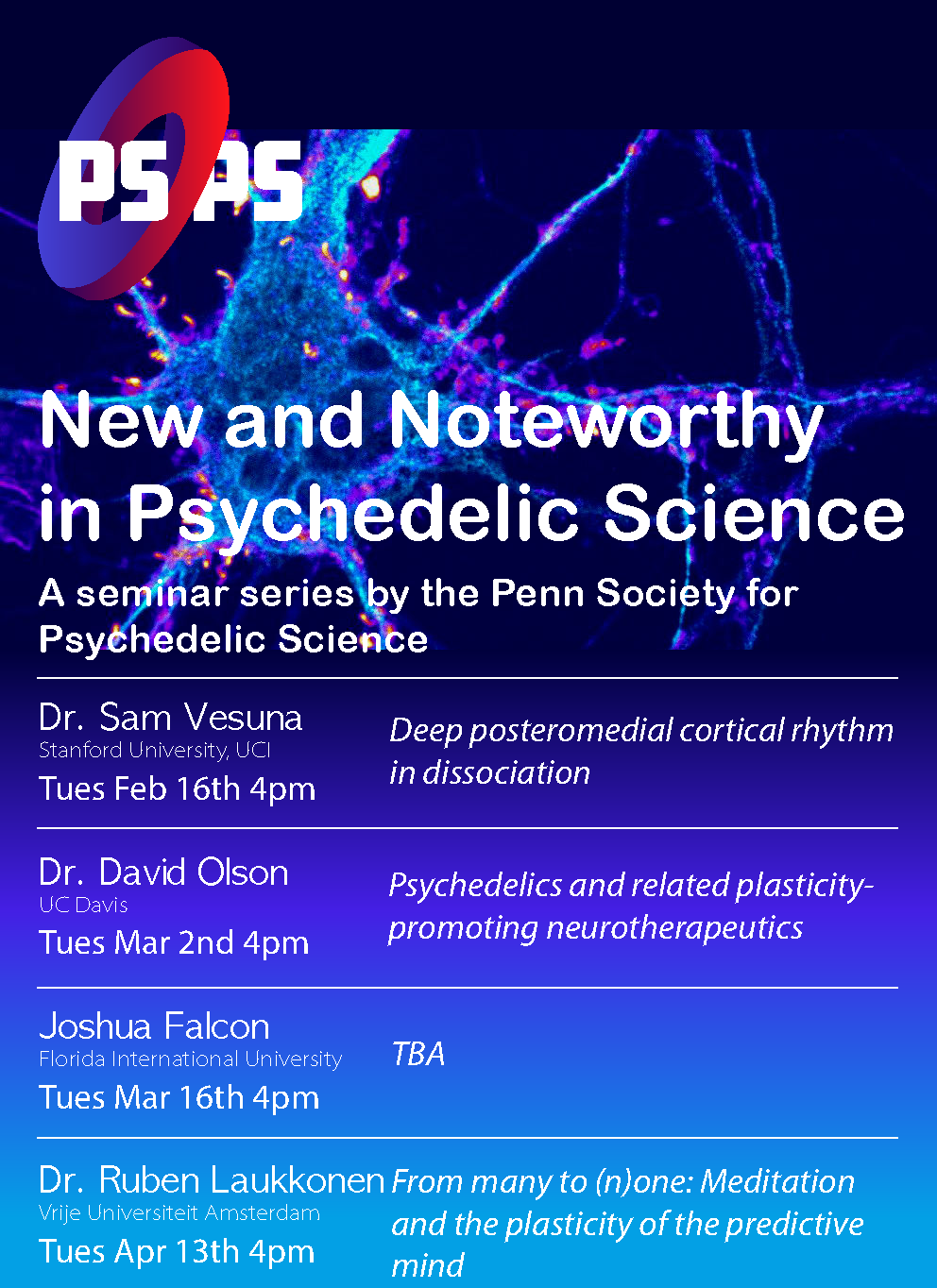
This semester, the Penn Society for Psychedelic Science is hosting a seminar series showcasing the broad range of research – from molecules, to brains, to societies – that is New and Noteworthy in Psychedelic Science. Join us roughly every other Tuesday at 4pm starting this Tuesday February 16th, where we are delighted to have Dr. Sam Vesuna. Dr. Vesuna performed research as an MD/PhD student in the Deisseroth lab at Stanford studying the neural circuits underlying self-self and self-other interactions. This week, he will be presenting his work on cortical circuits underlying ketamine-induced dissociative states, published in Nature.

Join us on future weeks to hear from Dr. David Olson, Joshua Falcon, and Dr. Ruben Laukkonen! Finally, we would love to thank BGSA for sponsoring this series and MindCORE for hosting us on their CrowdCast server. Register for Sam Vesuna, David Olson, Joshua Falcon, and Ruben Laukkonen at these links!

Filed Under: Announcements, Seminars Tagged With: Career: Research (academic)

SACNAS & BGSA Industry Career Panel

February 15, 2021 by Rebecca Lopez


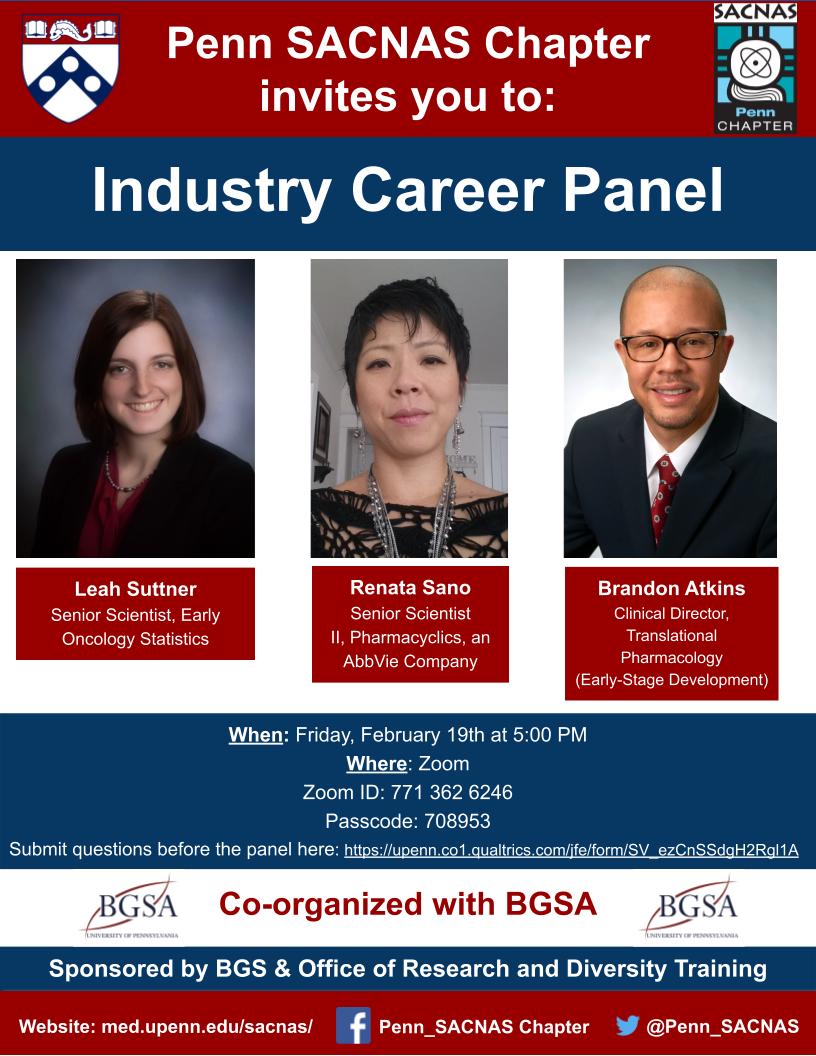
SACNAS is co-hosting an industry career panel with Penn BGSA this Friday, Feb 19th at 5 PM!

Submit your questions to the panel in advance: https://t.co/zBQijqbiuA?amp=1

Filed Under: Panels, Student Group Event Tagged With: Alumni, Alumni Speakers, Penn SACNAS

#BlackInCompBio seminar, “The Rubik’s Cube of Life: From Bioinformatics to Health Statistics”

February 15, 2021 by Rebecca Lopez

Image result for Black Women in Computational Biology Network

Happy Black History Month! 

Join the Black Women in Computational Biology Network on Wednesday, February 17th at 1:00 pm ET for another #BlackInCompBio seminar titled: “The Rubik’s Cube of Life: From Bioinformatics to Health Statistics.” Featuring Dr. ClarLynda Williams-DeVane, Ph.D. This event is open to the STEM community, all are welcome. 

ClarLynda Williams-DeVane is a health disparity informaticist.  Dr. Williams-DeVane currently serves as the director of North Carolina’s State Center for Health Statistics and North Carolina State Registrar.  She also serves as an Associate Professor of Data Science and Bioinformatics.  Dr. Williams-DeVane formerly served as the founding chair of the Data Science and Bioinformatics at Fisk University and an associate professor of Bioinformatics at NC Central University.  Dr. Williams-DeVane’s has focused on three main initiatives throughout her career 1) diversifying data science and bioinformatics towards having diverse perspectives at the table to solve demystify health equity by providing innovative, immersive educational experiences, 2) data curation creating accessible, digestible data sets, and 3) the use of computational approaches to explore the etiology of cardio-metabolic diseases and the co-morbidities that contribute to disparate outcomes.

Dr. Williams-DeVane earned her PhD in Bioinformatics from North Carolina State University, completed a Postdoctoral fellowship at the US Environmental Protection Agency, and lastly completed the Building Interdisciplinary Careers in Women’s Health fellowship in OB Gyn at Duke University School of Medicine. Dr. Williams-DeVane is currently focused on moving North Carolina forward in the battle against COVID19 and equitable health.

RSVP for the Zoom Link: https://www.blackwomencompbio.org/event-details/blackincompbio-seminar-series-clarlynda-williams-devane-ph-d

Filed Under: Seminars Tagged With: Competency: Mathematical and Computational Practices

Opportunity at SUNY for those interested in a career at a PUI

February 15, 2021 by Rebecca Lopez


Last year, the SUNY system started a major initiative to diversify the faculty on their campuses called PRODIG (Promoting Recruitment, Opportunity, Diversity, Inclusion and Growth). Part of this program is a fellowship program for those who are interested in teaching at a comprehensive college (aka, primarily undergraduate institution, or PUI).

The program is open to post-docs or those who have just completed or are finishing up their graduate degrees, who meet the eligibility criteria (underrepresented minority or WSTEM, must also be a U.S. citizen or permanent resident). It is a good deal for those who want/need to gain teaching experience and get a leg up on starting their academic career.

Some of the benefits include a two-year contract, a greatly reduced teaching load, professional development opportunities, mentoring, a stipend for summer research, and a moving allowance. PRODIG Fellows also get early notification regarding permanent tenure track positions in their discipline that become available within the consortium. Applicants would apply to the program and state preferences for which campuses they prefer, but they could receive an offer from any of the campuses.

Those who are interested can find more information and application instructions at the State University of New York PRODIG Fellowship website and SUNY Oneonta’s PRODIG Fellowship website.

Please reach out to BGS alumna (Biochemistry and Molecular Biophysics, 2002) Kelly Gallagher, PhD with any questions:

Kelly Gallagher, Ph.D. (she/her/hers)
Associate Professor and Chair
Department of Chemistry & Biochemistry
Email: kelly.gallagher@oneonta.edu

SUNY PRODiG logo - Promoting Recruitment, Opportunity, Diversity, Inclusion, and Growth

Filed Under: Jobs Tagged With: Career: Teaching (primarily undergraduate institution)

Discussion with Leonard Hayflick, PhD, 2020 Distinguished Graduate Award Recipient

February 12, 2021 by Rebecca Lopez


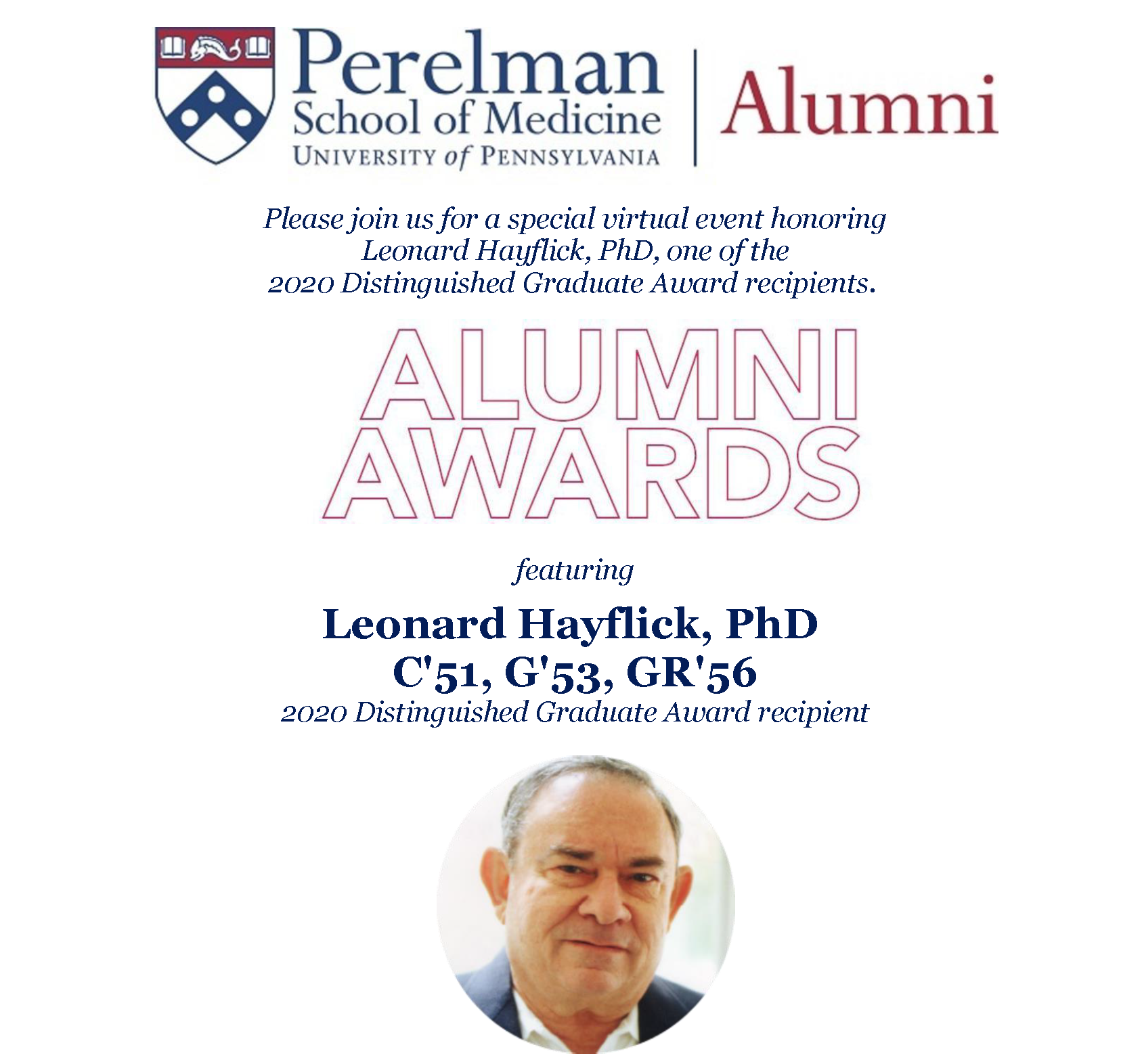
Date: 03/01/2021
Time: 3:00 PM to 4:00 PM EST
Location: Virtual Event via BlueJeans Events
Registration: www.alumni.upenn.edu/dga2020hayflick

Leonard Hayflick, C’51, G’53, GR’56, a native Philadelphian, is currently Professor of Anatomy at the University of California, San Francisco. In 1962, as a member of the Wistar Institute and an assistant professor at the University of Pennsylvania Medical School, he discovered that cultured normal human cells had a limited ability to divide, overturning a 60-year-old dogma that all cells are potentially immortal. He interpreted his discovery to be aging at the cell level, which launched the modern era of aging research by redirecting its cause to intracellular events.

He also discovered that only cancer cells are immortal, which redirected research to how mortal normal human cells become immortal cancer cells.

Hayflick found that frozen normal human cells “remembered” their doubling level after thawing and discovered that the counting mechanism was located in the cells’ nucleus. The Nobel Prize was awarded to those who found the molecular mechanism for Hayflick’s phenomenological discoveries. Chromosome ends (telomeres) shorten at each cell division until their “Hayflick Limit” is reached, but cancer cell immortality was caused by an enzyme (telomerase) that synthesizes the molecules lost from their telomeres.

Hayflick also discovered that normal human cells replicated every human virus then known and developed the technology that enabled safer vaccines, thus benefiting more than one billion people. He invented an inverted microscope for cell culture work that is the father of all current inverted microscopes. It has been accessioned by the Smithsonian Institution along with packages of polio and rabies vaccines produced in his normal human cell strain WI-38.

Hayflick discovered that the cause of “walking pneumonia” was not a virus, as previously believed, but mycoplasmas, the smallest free living microorganisms known. He named the organism Mycoplasma pneumoniae that he grew on a unique medium and used worldwide.

Among Hayflick’s many honors is the John Scott Award from the City Council of Philadelphia, the oldest scientific award in the United States. It was established in 1816 to honor Benjamin Franklin.

Filed Under: Announcements Tagged With: Alumni, Alumni Speakers

  • « Go to Previous Page
  • Page 1
  • Interim pages omitted …
  • Page 20
  • Page 21
  • Page 22
  • Page 23
  • Page 24
  • Interim pages omitted …
  • Page 107
  • Go to Next Page »

Primary Sidebar

Upcoming Events

Calendar

Professional Skills Series 2021-2022

Categories

  • Announcements
  • Articles
  • Conferences
  • Courses
  • Jobs
  • Online Resources
  • Panels
  • Seminars
  • Student Group Event
  • Symposia
  • Uncategorized
  • Webinars
  • Workshops

Tags

  • Alumni
  • Alumni Speakers
  • Career Services (Penn)
  • Career: Clinical care
  • Career: Consulting
  • Career: Entrepreneurship
  • Career: Financial/market analysis
  • Career: Grants management
  • Career: Medical science liaison
  • Career: Medical Writing
  • Career: Nonacademic pursuits in academia
  • Career: Nonprofit
  • Career: Patent law
  • Career: Policy
  • Career: Public health
  • Career: Publishing
  • Career: Regulatory affairs
  • Career: Research (academic)
  • Career: Research (government)
  • Career: Research (industry)
  • Career: Science writing
  • Career: Teaching (community college)
  • Career: Teaching (K-12)
  • Career: Teaching (primarily undergraduate institution)
  • Career: Teaching (university)
  • Career: Technology transfer
  • Center for Teaching and Learning (Penn)
  • Competency: Communication
  • Competency: Critical Thinking
  • Competency: Experimental Design
  • Competency: Management
  • Competency: Mathematical and Computational Practices
  • Ernest E. Just Biomedical Society
  • GLIA
  • Graduate & Professional Student Assembly (GAPSA)
  • Graduate Group: Biochemistry & Molecular Biophysics
  • Graduate Group: Cell & Molecular Biology
  • Graduate Group: Epidemiology and Biostatistics
  • Graduate Group: Genomics and Computational Biology
  • Graduate Group: Immunology
  • Graduate Group: Neuroscience
  • Graduate Group: Pharmacology
  • National Institutes of Health
  • National Science Foundation
  • Networking
  • News Media
  • Penn Bio Launch
  • Penn Biotech Group
  • Penn Graduate Consulting Club
  • Penn Graduate Women in Science and Engineering (PGWISE)
  • Penn SACNAS
  • Penn Science Policy & Diplomacy Group
  • Professional Skills: Diplomacy
  • Professional Skills: Informational Interviews
  • Professional Skills: Negotiation
  • Science: Working Life
  • Scientific Societies: ASBMB
  • Scientific Societies: ASCB
  • Video


Contact Us | Admin | Log in

Copyright © 2025 The Trustees of the University of Pennsylvania